Every growing business reaches a moment of friction. The template that launched your website starts fighting your ideas. The SaaS subscription you loved now charges per seat for features you barely use—and still can't do the one thing your team needs most. If that sounds familiar, you're facing the defining question of a scaling company: should you keep bending your business around off-the-shelf software, or invest in custom web application development that bends around you?
At LuaSoft, a woman-owned software consultancy, we help consulting firms, government contractors, and growing businesses make exactly this call. We have built custom CMS platforms, secure client portals, database-backed applications, and internal tools that replaced brittle spreadsheets and disconnected subscription software. This guide walks through the honest trade-offs of custom software vs off-the-shelf, the signs you've outgrown templates and SaaS, and how a custom app developer for business turns friction into a competitive advantage.
In this article, we cover:
- Off-the-shelf software vs custom development: the real trade-offs
- The signs your business has outgrown templates and SaaS
- The ROI of investing in custom software
- LuaSoft's approach, proof of work, and the industries and regions we serve
Off-the-Shelf Software vs Custom Development: The Real Trade-Offs
Off-the-shelf software—website templates, SaaS platforms, and packaged tools—exists for good reason. It's fast, inexpensive up front, and battle-tested by thousands of other users. For a brand-new business validating an idea, it's often the right first move. The trouble begins when your operations mature past what a one-size-fits-all product was designed to handle.
Where Off-the-Shelf Software Wins
- Speed to launch – You can be live in days, not weeks.
- Low initial cost – Monthly subscriptions spread expense over time.
- Maintained for you – The vendor handles updates and security patches.
- Proven functionality – Common workflows work out of the box.
Where Off-the-Shelf Software Falls Short
- You adapt to it, not the reverse – Your unique processes get squeezed into someone else's assumptions.
- Escalating costs – Per-seat pricing and add-on tiers balloon as you grow.
- Integration walls – Connecting multiple SaaS tools creates fragile, patchwork systems.
- No ownership – You rent access; the vendor controls the roadmap, your data, and your price.
- Feature ceilings – The one capability that would set you apart is the one you can't build.
Custom web application development flips this equation. Instead of renting a compromise, you own an asset built for your exact workflows, your data model, and your growth plan. The tradeoff is a larger up-front investment and a real development partner—but the payoff is software that becomes more valuable, not more limiting, as you scale.
Signs Your Business Has Outgrown Templates and SaaS
Most businesses don't wake up one day and decide to go custom. They accumulate friction until the cost of staying put exceeds the cost of building. Here are the clearest signals we see when clients come to us for custom software vs off-the-shelf guidance:
- You're paying for workarounds. Your team keeps spreadsheets, manual copy-paste steps, or third-party plugins alive just to make the software behave.
- Your tools don't talk to each other. Data lives in five disconnected systems, and someone re-keys it by hand.
- SaaS costs are climbing faster than revenue. Per-seat and per-feature pricing now rivals what a custom build would cost to own.
- A template is limiting your brand. You can't deliver the experience your customers expect because the platform won't allow it.
- You've hit a hard feature wall. The capability that would differentiate you simply isn't on any vendor's roadmap.
- Compliance or security demands more control. Government contractors and regulated firms often need ownership of data and infrastructure that SaaS can't provide.
If you recognize three or more of these, you've likely reached the point where a custom app developer for business will save you money and unlock growth rather than add overhead.
The ROI of Investing in Custom Software
The most common objection to custom development is cost. But smart businesses evaluate custom software vs off-the-shelf on total cost of ownership and long-term return—not sticker price. Here's where the ROI comes from:
- Eliminated subscription creep – A custom platform ends the compounding monthly fees of stacked SaaS tools.
- Recovered labor hours – Automating manual workarounds returns days of staff time every month.
- Higher conversion and retention – A tailored customer experience outperforms generic templates.
- Faster operations – Integrated systems remove the delays of re-keying and reconciling data.
- An owned, appreciating asset – Custom software adds to your company's valuation instead of being a recurring cost.
- Scalability without penalty – Growth doesn't trigger a new pricing tier; your platform simply scales with you.
For a growing consulting firm or government contractor, the math often becomes clear within 18 to 36 months: what you would have spent renting a compromise pays for owning a purpose-built solution that keeps paying dividends.
The LuaSoft Approach to Custom Web Application Development
As a custom software development company, LuaSoft builds on a modern, future-proof foundation and stays with you from strategy through launch and beyond. Our approach centers on ownership, scalability, and getting the details right.
1. A Modern, Scalable Technology Stack
We build with Next.js and React—the same technologies powering the fastest, most reliable web applications in the world. That means excellent performance, strong SEO, and an architecture that scales gracefully as your traffic and data grow. Your application is fast today and maintainable for years to come.
2. Custom CMS Development You Actually Control
Generic content management systems force you into their structure. Our custom CMS development gives your team an editing experience shaped around your content, your workflows, and your permissions—no plugin sprawl, no fighting the admin panel. When WordPress or Shopify is the right fit, we implement and extend those too; when they aren't, we build something better.
3. Integrations That Unify Your Systems
We connect the tools you already rely on—payment processors, CRMs, databases, and internal software—so data flows automatically instead of by hand. The result is one coherent system rather than a fragile patchwork of disconnected apps.
4. Databases and Automation Built for Your Data
From enterprise-grade databases to automation that eliminates repetitive tasks, we design data architecture around how your business actually works. Complex records, reporting, and search become fast and reliable instead of a daily headache.
5. True Ownership and Long-Term Partnership
When we build for you, you own it—the code, the data, and the roadmap. There's no vendor lock-in and no surprise price hikes. And because we're a small, senior consultancy, you work directly with the people building your software, not a rotating cast of account managers.
Proof of Work: A Custom Research CMS With Tiered Access
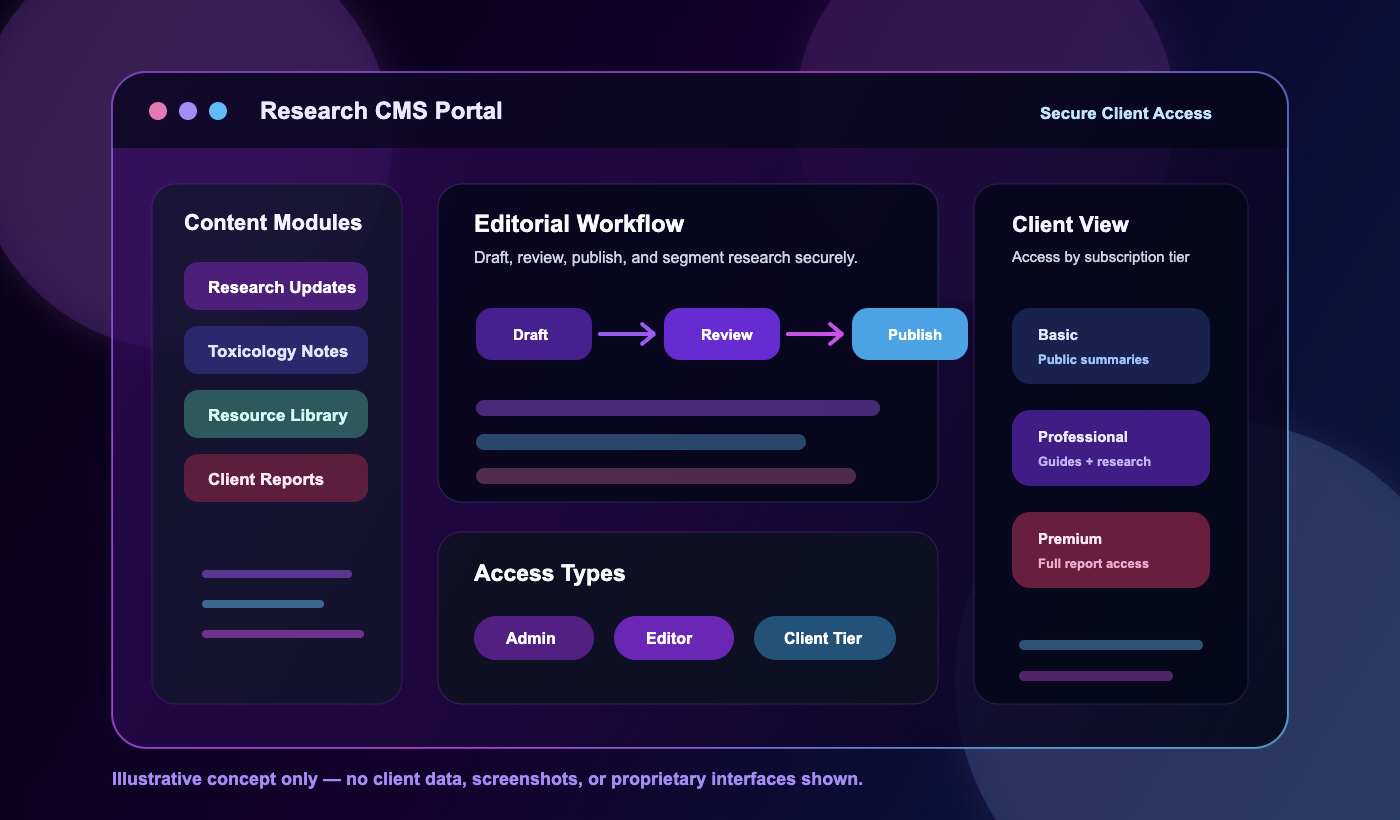
One of the clearest examples of custom web application development is not a public marketing site at all. It is the kind of private, operational platform that cannot be fully screenshotted or shown because it contains proprietary workflows, client information, and protected business logic. For that reason, the illustration in this article is intentionally NDA-safe: it explains the concept without exposing a client system.
A strong example is a custom CMS application LuaSoft built to help toxicology professionals manage research content, update technical material, and control who can access different parts of the system. Instead of forcing the team into a generic website builder or a cluttered plugin stack, the application was shaped around the real workflow: administrators can manage structure and access, editors can update research content, and clients can view only the material available to their subscription or access tier.
- Research and content management – Technical updates, resources, and research material can be organized in a CMS built around the subject matter, not a generic blog template.
- Role-based permissions – Administrators, editors, internal users, and client accounts can each receive the correct level of access.
- Tiered client visibility – Clients can see content based on the tier they pay for, making the platform useful as both an information system and a revenue-supporting product.
- Secure editing workflows – The team can update and publish information without exposing private notes, unpublished material, or restricted client resources.
- Scalable architecture – The system can evolve as research categories, user roles, subscriptions, and client needs grow.
That is the difference between a simple custom website and a custom web application: the application becomes part of how the business operates. It manages data, permissions, workflows, client experience, and monetization logic in one coherent system.
Industries and Regions LuaSoft Serves
We specialize in custom web application development for organizations that have outgrown templates and SaaS, including:
- Consulting firms – Client portals, proposal tools, and internal platforms that scale with your practice.
- Government contractors – Secure, ownable applications and databases that meet control and compliance needs.
- Growing businesses – Companies ready to replace subscription sprawl with a purpose-built platform.
- Creative and technical organizations – Portfolio platforms, data-heavy applications, and custom CMS builds.
As a woman-owned software consultancy, LuaSoft partners with clients across Florida, California, Las Vegas and Nevada, New York, Maryland, Virginia, Washington DC, and Canada. Whether you need a custom web app developer in Florida, a custom software development partner in California, or an application development team serving Canada, we deliver senior-level work with the personal attention only a boutique consultancy can offer.
Frequently Asked Questions (FAQs)
1. Custom software vs off-the-shelf: how do I know which is right for my business?
Choose off-the-shelf when your needs are common and you're validating an early-stage idea. Choose custom when you're paying for workarounds, hitting feature walls, stitching together disconnected tools, or when subscription costs rival the price of ownership. LuaSoft offers a free consultation to help you weigh the trade-offs honestly.
2. How much does custom web application development cost?
Cost depends on scope, integrations, and complexity. Rather than a sticker price, we help you evaluate total cost of ownership—comparing a one-time build you own against years of escalating subscriptions. Many clients find custom pays for itself within 18 to 36 months.
3. How long does a custom software project take?
Timelines vary with scope. A focused internal tool or custom CMS can ship in weeks, while a larger platform with multiple integrations may take a few months. We work in clear phases so you see progress early and often.
4. Do I actually own the software LuaSoft builds?
Yes. You own the code, the data, and the roadmap—no vendor lock-in and no surprise price increases. Custom software becomes a business asset you control, not a recurring cost you can't escape.
5. Can you integrate with the tools and SaaS platforms we already use?
Absolutely. We regularly connect custom applications with CRMs, payment processors, databases, WordPress, Shopify, and internal systems so your data flows automatically. Custom doesn't mean starting from scratch—it means unifying what you have.
6. Will a custom application scale as my business grows?
That's the point. Built on a modern Next.js and React stack with well-designed databases, your application scales with your traffic and data—without triggering the new pricing tiers that off-the-shelf tools impose as you grow.
Ready to Invest in Custom? Let's Talk
If your business has outgrown templates and SaaS, the smartest move isn't another subscription—it's a platform built around how you actually work. Custom web application development turns daily friction into a durable competitive advantage, and LuaSoft has the proof and the partnership approach to get you there.
Ready to stop renting compromises and start owning your software? Contact LuaSoft today for a free consultation, and let's build the custom solution your growing business deserves.